Review: The Exhibitionist by Charlotte Mendelson (2022)

Blurb

The longer the marriage, the harder truth becomes…

Meet the Hanrahan family, gathering for a momentous weekend as famous artist and notorious egoist Ray Hanrahan prepares for a new exhibition of his art – the first in many decades – and one he is sure will burnish his reputation for good.

His three children will be there: beautiful Leah, always her father’s biggest champion; sensitive Patrick, who has finally decided to strike out on his own; and insecure Jess, the youngest, who has her own momentous decision to make…

And what of Lucia, Ray’s steadfast and selfless wife? She is an artist, too, but has always had to put her roles as wife and mother first. What will happen if she decides to change? For Lucia is hiding secrets of her own, and as the weekend unfolds and the exhibition approaches, she must finally make a choice.

The Exhibitionist is the extraordinary fifth novel from Charlotte Mendelson, a dazzling exploration of art, sacrifice, toxic family politics, queer desire, and personal freedom.

Review

Many thanks to Mantle Books for sending me a proof copy of The Exhibitionist in exchange for an honest review.

I have just binge-watched Succession (I’m always slightly behind the times when it comes to TV!) and have realised just how much I enjoy really horrible protagonists. Ray Hanrahan is a deliciously awful man – egotistical in the extreme, utterly deluded in his sense of self-importance, and pretty vile to almost everyone around him. Fantastic stuff – but what makes it work best is that we orbit him at a slight remove, never entering into his point of view, but instead seeing him through the eyes of his supposed nearest and dearest.

Although it is a very different type of family drama, the roving viewpoint put me in mind of one of my favourite sagas, The Cazalet Chronicles by Elizabeth Jane Howard. Mendelson’s writing is sharper, closer to the bone, but it has that sweeping feel that I love so much in EJH’s books. We get to know all of the members of the Hanrahan clan – self-sacrificing Leah, whose entire life is dedicated to her father’s whims; Jess, who seems by far the most sensible member of the family; gentle Patrick, perhaps the most endearing of the bunch.

But the real heart of the story is Lucia, a talented artist in her own right, who has given up her dreams time and time again in order to try and preserve marital harmony with her beast of a husband. Her journey is an intricate, beautifully written transformation tale, and I really enjoyed seeing her change as the story progressed.

Mendelson’s writing is stunning; the prose is taut and surprising and full of piercing images that make you see the world afresh. I’m really looking forward to exploring this author’s back catalogue, and I’m sure that The Exhibitionist will gain her many new fans like me.

The Exhibitionist by Charlotte Mendelson is published by Mantle Books. A special edition with gorgeous stencilled edges is available here.

Review: The Green Indian Problem by Jade Leaf Willetts (2022)

Blurb

Set in the valleys of South Wales at the tail end of Thatcher’s Britain, The
Green Indian Problem is the story of Green, a seven year-old with intelligence
beyond his years – an ordinary boy with an extraordinary problem: everyone
thinks he’s a girl.


Green sets out to try and solve the mystery of his identity, but other issues
keep cropping up – God, Father Christmas, cancer – and one day his best
friend goes missing, leaving a rift in the community and even more
unanswered questions. Dealing with deep themes of friendship, identity, child
abuse and grief, The Green Indian Problem is, at heart, an all-too-real story of
a young boy trying to find out why he’s not like the other boys in his class.


Longlisted for the Bridport Prize (in the Peggy Chapman-Andrews category)

Review

I am a huge fan of indie publisher Renard Press, who published one of my favourite books of last year, This Good Book by Iain Hood. So I was delighted to be asked to be on the blog tour for their latest offering, The Green Indian Problem. Many thanks to the publisher for providing me with a proof copy of the book in exchange for an honest review.

Green, our narrator, is seven years old at the start of the novel. I have to confess that I sometimes struggle with child narrators; getting the balance between authenticity and readability is very tricky to pull off, and attempts at charming naivety often tip over into just plain annoying. (I’m the same with kids on screen). However, right from the start, I LOVED Green. The author has absolutely nailed the voice – he is engaging, funny, insightful and beautifully empathetic, all while sounding completely realistic as a young child. He has a unique way of looking at the world, cleverly reflected in the short, headed sections which cover everything from ‘Earth’ to ‘Conkers’ to ‘Rambo’ to ‘God.’ The structure works so well, echoing the child’s efforts to understand the world around him and his place in it.

Green’s central dilemma, that everyone sees him as a girl, is handled with poignancy and heart. When certain characters show glimmers of acceptance of who he really is, it feels like a glimpse of a better world, and when Green is denied the chance to express himself, you can feel the hurt and confusion. It’s a really moving story in and of itself, but Green’s identity is not the only plot point by any means. When Michael goes missing, the tone becomes more urgent, and the Green-as-detective sections are tense and thrilling. The setting, too, is woven into the story: Thatcher’s Britain and the difficulties faced by this small Welsh community spill over from the adults’ lives into their children’s.

There is such a subtle, beautiful combination of so many aspects in this book, from the political to the deeply personal, all told through the eyes of one of the most engaging protagonists I’ve come across for a long time. Green is a character who will stay with you, who will make you see the world a little differently, and who may even make you a better person for having spent time with him.

About the Author

Jade Leaf Willetts copyright Scarlett Arthur 2021

Jade Leaf Willetts is a writer from Llanbradach, a strange, beautiful village in South Wales. He writes about extraordinary characters in ordinary worlds and has a penchant for unreliable narrators. The Green Indian Problem, his first novel, was longlisted for the 2020 Bridport Prize in the Peggy Chapman-Andrews category. Jade’s poetry has been published by Empty Mirror, PoV Magazine and Unknown Press. His short story, ‘An Aversion to Popular Amusements’ was shortlisted for the inaugural Janus Literary Prize. He is currently working on a coming of age follow-up to The Green Indian Problem.

Author’s website: https://jadeleafwilletts.com

Purchase Links

Renard Press: https://renardpress.com/books/the-green-indian-problem/

Waterstones: https://www.waterstones.com/book/the-green-indian-problem/j-l-willetts/9781913724528

Bookshop.org: https://uk.bookshop.org/books/the-green-indian-problem/9781913724528

Blackwells: https://blackwells.co.uk/bookshop/product/The-Green-Indian-Problem-by-J-L-Willetts-author/9781913724528

Review: Good Intentions by Kasim Ali (2022)

Blurb

A heart-wrenching and beautifully told debut novel about love, family obligation and finding your way.

Nur and Yasmina are in love
They’ve been together for four happy years
But Nur’s parents don’t know that Yasmina exists

As Nur’s family counts down to midnight on New Year’s Eve, Nur is watching the clock more closely than most: he has made a pact with himself, and with his girlfriend, Yasmina, that at midnight he will finally tell his Pakistani parents the truth. That he has spent years hiding his personal life from them to preserve his image as the golden child. That he has built a life with a woman he loves and she is Black.

Nur wants to be the good son his parents ask him to be, and the good boyfriend Yasmina needs him to be. But as everything he holds dear is challenged, he is forced to ask, is love really a choice for a second-generation immigrant son like him?

Deftly exploring family obligation and racial prejudice alongside the flush of first love, Good Intentions is a captivating and powerful modern love story that announces a thrilling new voice in British fiction.

Review

Many thanks to 4th Estate and the Squadpod for arranging a proof copy for me in exchange for an honest review.

I enjoyed so many things about Good Intentions, but one of the aspects I loved the most was its nuance. The story feels fresh and modern, and it elegantly negotiates the complexities of Nur’s situation without either getting didactic or simplifying the issues. I did get frustrated with him at times, but he’s a sympathetic protagonist, and he’s doing what he feels is right, however misguidedly. As someone who suffers with anxiety, I thought the sections where Nur experiences struggles with his mental health were really well done – and it was refreshing to see other characters accepting those parts of him.

At its heart, Good Intentions is a great contemporary love story: the relationship between Nur and Yasmina is so realistically portrayed, I absolutely thought of them as real people as I was reading. I love the banter between them, the witty back-and-forth, their utter irritation with each other which strengthens rather than undermines their feelings for each other. Their exchanges are funny and intelligent, and they’re just a wonderful couple to spend time with. Of course, this makes it all the more poignant when they encounter difficulties – we’re rooting for them so hard.

There is so much going on in this book, but it never feels like an effort to read. The story carries you along, and the clever non-linear structure allows us to build up a picture of the relationship in scenes that are both self-contained and part of a whole. It’s very intelligent writing, and I look forward to reading more by this author in the future.

Good Intentions by Kasim Ali is published by 4th Estate and is available to purchase here.

February 2022 Reading: Black Drop; The Marsh House

February was not a great reading month for me in terms of quantity – and I wasn’t even going to post a wrap-up – but for the sake of continuity, and because I really enjoyed the two books I DID manage to read, here is my February reading!

Black Drop by Leonora Nattrass (2021)

A fantastically intricate historical novel, full of intrigue and secrets and lies. It’s hard to believe this is a debut novel! You can read my full review of Black Drop here.

The Marsh House by Zoe Somerville (2022)

I was a huge fan of Zoe Somerville’s first novel, The Night of the Flood, and I loved this one just as much! I was honoured to be offered a spot on the blog tour for The Marsh House – you can read my full thoughts on this wonderfully atmospheric story here.

So that was it for February! Short and sweet! Sometimes life gets in the way of reading, and that’s okay. There’s always another month!

Happy reading!

Ellie x

Review: Black Drop by Leonora Nattrass (2021)

Blurb

This is the confession of Laurence Jago. Clerk. Gentleman. Reluctant spy.

July 1794, and the streets of London are filled with rumours of revolution. Political radical Thomas Hardy is to go on trial for treason, the war against the French is not going in Britain’s favour, and negotiations with the independent American colonies are on a knife edge.

Laurence Jago – clerk to the Foreign Office – is ever more reliant on the Black Drop to ease his nightmares. A highly sensitive letter has been leaked to the press, which may lead to the destruction of the British Army, and Laurence is a suspect. Then he discovers the body of a fellow clerk, supposedly a suicide.

Blame for the leak is shifted to the dead man, but even as the body is taken to the anatomists, Laurence is certain both of his friend’s innocence, and that he was murdered. But after years of hiding his own secrets from his powerful employers, and at a time when even the slightest hint of treason can lead to the gallows, how can Laurence find the true culprit without incriminating himself?

A thrilling historical mystery, perfect for readers of C.J. Sansom, Andrew Taylor, Antonia Hodgson and Laura Shepherd-Robinson.

Review

I like to think I have pretty broad tastes when it comes to reading, but in all honesty, historical fiction is where my heart really lies. I picked up Black Drop from Bert’s Books as a Christmas present to myself (that’s totally a thing, right?) and had been looking forward to diving in.

It did not disappoint. As the daughter of a diplomat, I do enjoy a bit of political intrigue, and I was totally engrossed by the Foreign Office setting. There is quite a lot to keep track of, but Leonora Nattrass is such a skilful storyteller that as the web grows more tangled, the tension ramps up, and I found myself racing through the pages. Laurence Jago is a great protagonist – I do like a flawed narrator – and it is a pleasure to follow him on his thrilling adventures through the streets of London.

The sense of threat around every corner, of the real peril in which Jago finds himself, is wonderfully done, and his dependence on the ‘black drop’ heightens the paranoia and feeling of unease. This is a superbly dark and twisty historical thriller, with some fantastic set pieces: I especially enjoyed the scenes at the menagerie. Like Laurence, I found myself unsure who to trust, assessing characters with a suspicious mind, not taking anyone at face value. It’s a tremendously engaging and fun position to be in as a reader.

Black Drop is astonishingly accomplished; an intricate story plotted with incredible attention to detail. And I am very excited that Laurence Jago will return in the sequel, Blue Water, coming later this year – it’s on my list already!

Black Drop by Leonora Nattrass is published by Viper Books and is available to purchase here.

Review: At Night All Blood Is Black by David Diop translated by Anna Moschovakis (2021)

Blurb

Winner of the International Booker Prize 2021

Alfa and Mademba are two of the many Senegalese soldiers fighting in the Great War. Together they climb dutifully out of their trenches to attack France’s German enemies whenever the whistle blows, until Mademba is wounded, and dies in a shell hole with his belly torn open.

Without his more-than-brother, Alfa is alone and lost amidst the savagery of the conflict. He devotes himself to the war, to violence and death, but soon begins to frighten even his own comrades in arms. How far will Alfa go to make amends to his dead friend?

At Night All Blood is Black is a hypnotic, heartbreaking rendering of a mind hurtling towards madness.

Review

I’ve had this book on my shelf for a little while, and I’m trying to mix up reading arcs with books I’ve actually bought this year, so I picked it up.

At Night All Blood Is Black is an incredibly intense read – short but so powerful; it left me reeling. The prose is so rhythmic, with repeated refrains such as ‘God’s truth’ and ‘I know, I understand’ echoing throughout the pages – it almost feels like reading poetry. This book is not for the faint-hearted: it plunges the reader headlong into the visceral madness of war, blood and guts spilling and atrocities piling up along with the bodies. But as hard as it is to face up to the violence, the story is also about love and friendship, with the relationship between the narrator and his more-than-brother Mademba firmly at its centre.

The style of writing reminded me at times of Cormac McCarthy – there is a terrible beauty in the way horrors are shaped into words by a skilful hand. But it’s also utterly unique – I can’t compare it to another reading experience. Awful and awe-inspiring, Diop’s tale of the so-called Great War stands apart as a fierce, captivating examination of the effects of cumulative violence. It is certainly a novel that will stay with me.

At Night All Blood Is Black by David Diop translated by Anna Moschovakis is published by Pushkin Press and is available to purchase here.

Review: The Marsh House by Zoe Somerville (2022)

Blurb

Part ghost story, part novel of suspense The Marsh House is the haunting second novel from the author of The Night of the Flood where two women, separated by decades, are drawn together by one, mysterious house on the North Norfolk coast.

December, 1962. Desperate to create a happy Christmas for her young daughter, Franny, after a disastrous year, Malorie rents a remote house on the Norfolk coast. But once there, the strained silence between them feels louder than ever. As Malorie digs for decorations in the attic, she comes across the notebooks of the teenaged Rosemary, who lived in the house thirty years before. Trapped inside by a blizzard, and with long days and nights ahead of her, Malorie begins to read. Though she knows she needs to focus on the present, she finds herself inexorably drawn into the past…

July, 1931. Rosemary lives in the Marsh House with her austere father, surrounded by unspoken truths and rumours. So when the glamorous Lafferty family moves to the village, she succumbs easily to their charm. Dazzled by the beautiful Hilda and her dashing brother, Franklin, Rosemary fails to see the danger that lurks beneath their bright facades…

As Malorie reads Rosemary’s diary, past and present begin to merge in this moving story of mothers and daughters, family obligation and deeply buried secrets.

Review

I was a huge fan of Zoe Somerville’s debut novel, The Night of the Flood, so I was delighted to be asked to join the blog tour for her second book. Thanks to Head of Zeus for providing me with a copy of the book in exchange for an honest review.

Like her first novel, which is also set in Norfolk, The Marsh House is dripping with atmosphere – the saline stench of the marsh; the encroaching weather that threatens to trap them in the house; a sense of menace folded into the landscape. In this story, the dual timeline adds an extra layer. As Malorie delves into the secrets hidden in the house, parallel lives slide into view, and I found myself captivated by both storylines.

Malorie’s escape from London, from her marriage, is hasty and unplanned, and at times there is a real sense of peril in her and her daughter’s isolation. The house does not feel like a sanctuary; rather, it throbs with a kind of sinister energy that at times seems to echo Malorie’s own unsteady state of mind, and at other times feels more supernatural. The writing reminded me of Rebecca Netley’s excellent novel The Whistling – both books expertly play with gothic conventions and elements of more traditional ghost stories while creating something new. It is writing that fully engages the senses, that holds you tightly in its icy grip.

Rosemary is also a fascinating character, and the chapters from her notebooks gradually reveal an intricate web of betrayals and tragedies. The author is so skilful in pulling back just at the moment of a reveal, leaving the reader as impatient as Malorie to find out what happens next. And, like Muriel in The Night of the Flood, there is a character who seems peripheral, but whose role slowly moves towards the centre: Janey, whose voice functions as a kind of chorus, and whose knowledge of folklore and tradition adds a richness, a sense of something elemental and raw.

This is writing that is both clever and thrilling: a tightly-plotted story that nevertheless leaves room for the reader to breathe, to make their own interpretations. I highly recommend getting your hands on The Marsh House and losing yourself within its richly drawn pages.

The Marsh House by Zoe Somerville is published by Head of Zeus and is available to purchase here.

Zoe’s first novel, The Night of the Flood, is now out in paperback here.

Zoe will be at Waterstone Norwich on Wednesday 23rd March talking with fellow author Polly Crosby – if you’re local, don’t miss it! Details here.

January 2022 Reading: I Love You but I’ve Chosen Darkness; Great Circle; Sorrow and Bliss; This One Sky Day; Magpie; The Happiness Factory; Wahala; A Net for Small Fishes; The Confessions of Frannie Langton; The Last House on Needless Street; At Night All Blood Is Black

I’ve been on such a roll with reading this month, and have loved every single book I’ve chosen. As usual, I’ve gone for quite a mix, but I’d happily recommend all eleven of these beauties!

I Love You but I’ve Chosen Darkness by Claire Vaye Watkins (2022)

I really enjoyed this bold, original book. A fascinating and courageous exploration of what happens when a woman realises the roles of wife and mother are not ones she can play any longer, I Love You but I’ve Chosen Darkness is a powerful read. You can see my full review here.

Great Circle by Maggie Shipstead (2021)

This is a stunning, epic novel that I wish I’d read sooner. I was slightly put off by its size, but, appropriately enough, I flew through it. A wonderful story, one that will stay with me. My full review of Great Circle is here.

Sorrow and Bliss by Meg Mason (2021)

I was initially reluctant to read this because of all the hype, but that was foolish of me. Sorrow and Bliss is an addictive, funny, moving read that I absolutely loved. Read my full review here.

This One Sky Day by Leone Ross (2021)

I had a feeling this book would be right up my street, and it absolutely was. A strange, wonderful novel, full of colour and magic and beauty and human messiness. I adored it. You can read my full review of This One Sky Day here.

Magpie by Elizabeth Day (2021)

This was another gripping read – I devoured it in one sitting. Read my full review here.

The Happiness Factory by Jo McMillan (2022)

Bluemoose Books never disappoints – and The Happiness Factory is no exception. A fresh, original story with a protagonist who captured my heart. My full review is here.

Wahala by Nikki May (2022)

Another book I just couldn’t put down, Wahala is a fantastic debut full of comic touches, female friendship, refreshing insights and unexpected twists. I loved this novel, and I want Ronke to be my best friend. My full review of Wahala is here.

A Net for Small Fishes by Lucy Jago (2021)

I enjoyed this story of friendship and intrigue in the Jacobean court so much. I was completely immersed in the world that Jago paints, and Anne and Frankie’s relationship is beautifully nuanced and engrossing. My full review is here.

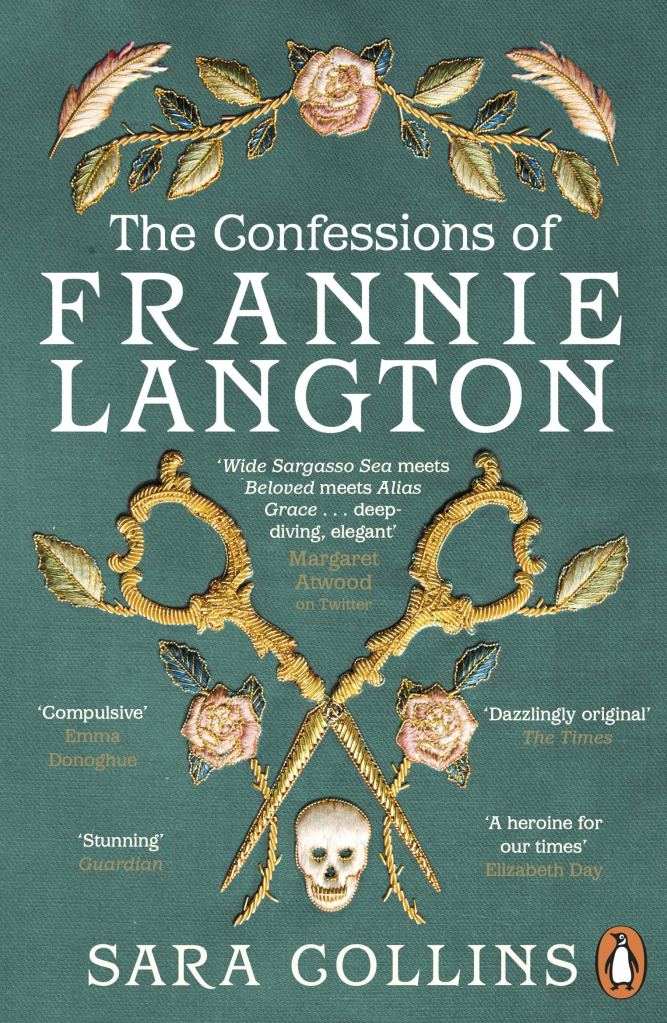
The Confessions of Frannie Langton by Sara Collins (2019)

This is a brilliant historical fiction novel, and has shot into my top reads of all time! I can’t recommend it highly enough. You can read my full review here.

The Last House on Needless Street by Catriona Ward (2021)

I am still undecided as to whether to write a full review of this outstanding novel, as I think my main advice is: “Trust me, just read it!” I feel like the less you know going in, the better – have faith in Ward’s incredible skills and ride the story wave to the very end. One of the cleverest books I’ve ever read.

At Night All Blood Is Black by David Diop translated by Anna Moschovakis (2021)

This winner of the International Booker Prize is a lyrical, powerful, strange book that held me in its grip throughout. I’ll try and get a full review up soon, but this was an unforgettable read.

A great reading month has been a wonderful way to kick off 2022, and I’m excited to see what the rest of the year brings! Do let me know if you’ve read any of these, or if you’re planning to!

Happy reading!

Ellie x

Review: The Confessions of Frannie Langton by Sara Collins (2019)

Blurb

‘They say I must be put to death for what happened to Madame, and they want me to confess. But how can I confess what I don’t believe I’ve done?’

1826, and all of London is in a frenzy. Crowds gather at the gates of the Old Bailey to watch as Frannie Langton, maid to Mr and Mrs Benham, goes on trial for their murder. The testimonies against her are damning – slave, whore, seductress. And they may be the truth. But they are not the whole truth.

For the first time Frannie must tell her story. It begins with a girl learning to read on a plantation in Jamaica, and it ends in a grand house in London, where a beautiful woman waits to be freed.

But through her fevered confessions, one burning question haunts Frannie Langton: could she have murdered the only person she ever loved?

A beautiful and haunting tale about one woman’s fight to tell her story, The Confessions of Frannie Langton leads you through laudanum-laced dressing rooms and dark-as-night back alleys, into the enthralling heart of Georgian London.

Review

I’ve read some fantastic historical fiction recently, confirming that it really is my favourite genre. Lots of people recommended The Confessions of Frannie Langton when I asked what I should read next. They were absolutely right – I LOVED it.

There are so many elements that make this a brilliant read. I love a book where the first person narration has a strong purpose, and here, Frannie is setting down her record not to clear her name, but to tell her story and work out what happened. This means that we’re right alongside her as she pieces together her history and the events that led to the night of the murders, and it’s a thrilling position to be in as a reader. Frannie herself is a compelling protagonist; although at first it seems she is at the (lack of) mercy of her fate, she is far from passive, forging her own path in myriad ways, living and loving fiercely, able to see the world in a much more clear-sighted manner than many of the other characters.

As well as fascinating characters, Frannie Langton has a propulsive plot – Sara Collins is extremely talented at knowing when to withhold and when to reveal key information, balancing the mysteries and the revelations with consummate skill. Like Frannie, Collins is first and foremost a storyteller, and what a story it is. With so many layers of narrative at play, a lesser writer might struggle to balance them all, but here, it works beautifully, the shocks coming with just enough subtle foreshadowing to be completely cohesive and believable.

I could probably wax lyrical about this book for pages – I’ve yet to mention the sharp, vivid prose, full of startling metaphors and similes that feel fresh and new, or the many other engaging characters, such as Madame, Phibbah, and Laddie, who are drawn with multi-faceted complexity – but there’s a danger I’ll bore you all with my enthusiasm, so I’ll stop here. All I’ll say is that if you’re a fan of historical fiction along the lines of Alias Grace or Washington Black, and you haven’t read The Confessions of Frannie Langton yet, you’re missing out. Get on the case – you won’t regret it!

The Confessions of Frannie Langton by Sara Collins is published by Penguin and is available to purchase here.

Review: A Net for Small Fishes by Lucy Jago (2021)

Blurb

Based on the true scandal that rocked the court of James I, A Net for Small Fishes is the most gripping novel you’ll read this year: an exhilarating dive into the pitch-dark waters of the Jacobean court.

Frances Howard has beauty and a powerful family – and is the most unhappy creature in the world. Anne Turner has wit and talent – but no stage on which to display them. Little stands between her and the abyss of destitution. When these two very different women meet in the strangest of circumstances, a powerful friendship is sparked. Frankie sweeps Anne into a world of splendour that exceeds all she imagined: a Court whose foreign king is a stranger to his own subjects; where ancient families fight for power, and where the sovereign’s favourite may rise and rise – so long as he remains in favour.

With the marriage of their talents, Anne and Frankie enter this extravagant, savage hunting ground, seeking a little happiness for themselves. But as they gain notice, they also gain enemies; what began as a search for love and safety leads to desperate acts that could cost them everything.

Review

A Net for Small Fishes has everything a good historical fiction novel should have: gloriously rich descriptions, light but impeccable period details, a thrilling plot, and, most importantly, unforgettable characters.

The friendship between Anne and Frankie is what propels this story along, and it is beautifully depicted. At times it seems almost like a love story, as the two women become more and more intertwined, and their similarities and differences become more apparent. I loved the intense focus on these two characters – it adds an intimacy to the sweeping political drama of the Jacobean court, pushing kings and men to the side to zoom in on an intensely personal relationship. It works so well, and I was captivated till the last page.

Anne is a great first person protagonist, standing on the edge between two worlds: the sumptuous excess of life at court and the constant threat of poverty, exacerbated by her changing circumstances as the novel progresses. Through her, we are allowed to see all walks of life – she has a unique insight into society that provides a clear-eyed perspective. She is also capable of seeing her friend’s flaws; even while she is dazzled by the life that Frankie can offer her, she is aware that if Frankie doesn’t play the game right, it could all come crashing down for both of them. There is real peril here, which only increases as the story goes on.

Jago immerses the reader in the sights, sounds and smells of Jacobean England: the fetid stench of the Thames in summer; the ornate furnishings of noble bedchambers; the spectacle of the bear pit – reading this book is such a sensory experience. It’s also incredibly emotionally powerful – I was so invested in the characters, anxious at every fluctuation in their fortunes. This is historical fiction at its finest, and I am definitely going to seek out more work by this author.

A Net for Small Fishes by Lucy Jago is published by Bloomsbury and is available to purchase here.