Review: Tapestry by Beth Duke (2020) @bethidee @damppebbles #damppebblesblogtours

Blurb

Twenty-one-year-old Skye Willis lives in Eufaula, Alabama, a tourist mecca of stately homes and world-class bass fishing. Her childhood friends are either stuck at dead ends or have moved on to accomplish Big Things.

Skye’s grandmother, Verna, insists on being called “Sparrow” because she suspects her ancestors were Muscogee Creek. She dresses in faux deerskin and experiments with ancient Native American recipes, offering a myth or legend to anyone who will listen.

Skye has no idea what to do with her life. She’s smart as hell, but she has no faith or knowledge there’s something out there she was “born to do.” Nor does she know much of anything about her father, who died in Afghanistan when she was a toddler. He and his family are a mystery her mother won’t discuss. But when Sparrow sets out to confirm her Creek ancestry through genetic testing, Skye joins in.

The results hit like a DNA bomb, launching them both on a path filled with surprises and life-changing events. Skye learns a harder truth than she ever expected.

Alternating chapters between Skye’s Alabama life and an intertwining tale of greed, deceit, and control in Texas, this story offers proof that all life is a woven tapestry of past, present, and future.

In Beth Duke’s uplifting and soul-singing voice, TAPESTRY is Southern Fiction at its best; you will cry, you will laugh out loud, and you will wish you were a member of the beautiful, matriarchal family Duke has created for her readers.

This book is a must-read for fans of Fannie Flagg, Anne Rivers Siddons, and Rebecca Wells.

Review

Thank you to the author and to Emma at Damp Pebbles for my spot on this blog tour. I received a copy of the book in exchange for an honest review.

I really enjoyed this book. I have read some quite serious, dark fiction this year, and it was a refreshing delight to follow Skye and her family on their quirky, twisty journey. I loved the characters, especially Skye’s grandmother, Verna, whose devotion to her possible heritage is more than just an endearing eccentricity: it is an assertion of identity. But even the more minor characters are wonderfully drawn, from Skye’s mother’s new beau to his mother, each is given care and attention. This is a very loving book – you can feel the author’s big heart in every page.

Large themes are given space here, but they never overwhelm the narrative, which is a fun, unexpected ride that carries the reader along. Skye’s first person narration rings true – so much so that I definitely felt the age difference between us and found myself occasionally raising my eyebrows at her twenty-something mindset, but I think that says more about my age and cynicism! She is a sympathetic protagonist, and I wished her well at every turn. Her father is a more complicated character than he initially appears, and I liked his development as the book progressed. His wife, the fabulously dislikable Kara Darling, is the only character in the book who teeters on soap-operarish caricature, but her sections allow Duke to fully indulge her excellent sense of humour, and provide some highly entertaining drama, so I actually didn’t mind at all, and looked forward to Kara appearing on the page to stir up more trouble!

Tapestry was great fun to read. It is almost like reading two books in one: an uplifting, sweeping tale of a wonderfully idiosyncratic matriarchal family, and alongside, a comeuppance story about a Dallas/Dynasty-esque female villain. The non-traditional family values and the warmth at the heart of this book feel like a giant literary hug, and that is a beautiful thing. I would recommend this book to anyone who likes a good story told with a light touch and plenty of love.

About the Author

Beth Duke

Beth Duke is the recipient of short story awards on two continents and is eyeing the other five.

She lives in the mountains of her native Alabama with her husband, one real dog, one ornamental dog, and a flock of fluffy pet chickens.

She loves reading, writing, and not arithmetic.

Baking is a hobby, with semi-pro cupcakes and amateur macarons a specialty.

And puns—the worse, the better.

Travel is her other favorite thing, along with joining book clubs for discussion.

Please invite her to London…England or Kentucky, either is fine. Anywhere!

Social Media

Twitter: https://twitter.com/bethidee

Facebook: https://www.facebook.com/pg/TapestryByBethDuke/posts/

Website: https://www.bethduke.com/

Instagram: https://www.instagram.com/onlythebethforyou/

BookBub: https://www.bookbub.com/authors/beth-duke

Purchase Links

Amazon US: https://amzn.to/306lErk

Amazon UK: https://amzn.to/3gWFnkl

Book Depository: https://bit.ly/2C2pgTl

Barnes and Noble: https://bit.ly/38NgBjC

Tapestry was published in paperback, digital and audio formats by The Art of Dixie on 8th February 2020.

Blog Tour: Champion by Stephen Deutsch (2020) – EXTRACT #Champion #StephenDeutsch @Bookollective @UnicornPubGroup

I am very excited to bring you an extract from Stephen Deutsch’s new novel, Champion. Thank you to Aimee at Bookollective for my spot on the tour. Yesterday, Linda did a fantastic interview and extract post, Staying in with Stephen Deutsch, and today I am bringing you a further taste of the book. I hope this extract gives you a flavour of this dramatic story! For more on Champion, check out the excellent bloggers and bookstagrammers on the tour, which runs until 27th July!

Blurb

Dark haired, slight, with deep-set haunted eyes, Herschel Grynszpan is an undocumented Jewish alien living in Paris. He receives a postcard from his parents – recently bundled from their Hanover flat, put on a train and dumped, with 12,000 others on the Polish border. Enraged, Herschel buys a gun and kills a minor German official in the German Embassy. The repercussions trigger Kristalnacht, the nationwide pogrom against the Jews in Germany and Austria, a calamity which some have called the opening act of the Holocaust.

Intertwined is the parallel life of the German boxer, Max Schmeling, who as a result of his victory over the then ‘invincible’ Joe Louis in 1936 became the poster boy of the Nazis. He and his movie-star wife, Anny Ondra, were feted by the regime – tea with Hitler, a passage on the airship Hindenburg – until his brutal two-minute beating in the rematch with Louis less than two years later. His story reaches a climax during Kristalnacht, where the champion performs an act of quiet heroism.

Extract

Chapter 16 – Buying a Gun

City noises jarred him awake. His immediate thought was that he should start his morning prayers. He looked for his tallis bag, then remembered that he had left it in his uncle’s flat. A disappointed shrug. God will forgive me after all I’ve been through. He rang for breakfast. After a few minutes, as he washed his face then smoothed his rumpled clothes as best he could, he heard a soft knock. When he opened the door, he found a tray of food at his feet – croissant, jam, butter, and coffee. He was hungry. Though the croissant was stale and tasteless, he ate it all. His familiar heartburn began immediately. And as usual, this gastric rebellion was accompanied by anxious thoughts, the mantra of worries which accompanied him everywhere, sometimes suppressed by diversions, but always lurking.

He removed a postcard from the inside pocket of his jacket and studied it. On the front, a formal monochrome photograph taken a few months earlier, in a busy, shabby photographer’s studio near the Pigalle, much recommended by his friends. Wearing a three-piece suit and tie, he stared straight at the camera, his attitude both serious and haughty, his black hair slicked back, an unlit cigarette resting nonchalantly between two fingers of his left hand, his right arm held behind his back. He thought the result both flattering and lifelike.

He fished the nub of a pencil from his jacket pocket and, sitting on the edge of the bed, wrote on the other side of the card:

My dear family, I couldn’t do otherwise. God must forgive me. My heart bleeds when I think of our tragedy. I have to protest in a way that the whole world will hear, and this I intend to do. I beg your forgiveness.

He signed the card and addressed it to his aunt and uncle then placed it in his wallet.

Leaving the hotel quickly, he strode along the Boulevard de Strasbourg, now filling with pedestrians, lorries and buses.

He arrived at A la Fine Lame, the gun-shop he had discovered on the previous evening. A middle-aged woman was raising the door shutters, the metallic clatter breaking through the noise of the traffic. He followed her into the shop. She studied him warily. He seemed to her a contradiction; well dressed, wearing expensive clothes, poised – yet unkempt, creased, unshaven.

‘Monsieur?’ she enquired, her eyebrows betraying her uneasy curiosity.

He needed some time to formulate what he intended to say into the best French he could manage. He looked around the dark shop, crammed with a large display of handguns in glass display-cases, mostly pistols and revolvers. Rifles and shotguns were mounted on the walls behind the counter. Satisfied with his inner rehearsal, he turned to her.

‘I need to buy a gun. It is because my father often…’

‘If you will excuse me for a moment, Monsieur, I’ll call my husband, Monsieur Carpe, who will be happy to advise you.’

Monsieur Carpe arrived before she could fetch him; stocky, sporting a moustache which Herschel thought was slightly too fulsome for his face. His wife went to open the window shutters. Morning light fell onto the wooden floor. He smiled at the young man.

‘Why do you need a gun?’

‘Well,’ he replied, calming himself so that his voice didn’t quaver, ‘my father is a German merchant who has me to carry large sums of money for him, so I need something to protect myself, things in the world being as they are.’

‘What sort of gun are you looking for?’

‘I was thinking a 45. Like in the movies.’

Carpe scowled. ‘The movies are not real life, Monsieur. A 45 is too heavy. Not for you, my son. What you need is a weapon that a person of your build could handle more easily. Something small, which, by the way, will also not spoil the lines of your jacket.’

He removed a small ‘hammerless’ pistol from the display case, demonstrating its lightness by passing it nimbly between his hands.

‘It holds five rounds, perhaps a bit cumbersome to reload. But I don’t expect someone like you will be in any gun battles. It’s easy to use and accurate at short range, maybe up to twenty metres, depending, of course, on how well you aim.’

Carpe then explained the safety mechanism. He loaded then unloaded the weapon. He demonstrated the ease of the trigger mechanism, then handed the pistol to Herschel, who pointed the gun at the ceiling and pulled the trigger five times. This all fascinated the boy. The gun seemed simple to him, far less complicated than any sewing machine.

‘This particular item costs 210 Fr, plus 35 Fr for a box of 25 bullets.’

He removed the three one-hundred-franc notes from his wallet and pushed them across the counter.

Carpe smiled, pushing the money back. ‘Not quite yet, Monsieur. There is no hurry. It’s early in the day, not so? First I need to take down your name and address and to see your identity papers.’

He handed Carpe his German passport, and stated his address as 8 rue Martel. After completing the registration form, he passed it to Carpe, who stamped it and handed it back, after writing the details into a ledger.

‘You are required by law to take this form to a police station, which as it happens, is just around the next corner. In France, every weapon must be registered.’

‘Yes, I understand.’

He handed the three 100 Fr notes to Carpe, and received his change, which Carpe removed from a drawer in a maple bureau behind him, having opened it with a small black key, one among many dangling at the end of a long silver keychain. Carpe wrapped the gun and ammunition in brown paper sheets and secured the packages with string. The boy put the packages into his overcoat pocket and walked to the door, nodding in the direction of Mme Carpe, who was busy dusting display cases.

‘You turn left at the next corner. You’ll see the police station ahead of you,’ Carpe reminded his agitated young customer.

He left the shop, closing the door quietly. He turned left and walked purposefully down the busy street in the direction of the police station. After a few steps, he abruptly changed his course, almost colliding with a surprised pedestrian. He hurried towards Tout va Bien. Entering the café quickly, he mutely acknowledged the patron, who was fiddling with an ancient coffee machine. Relieved that none of his friends were there, he walked to the washroom and was instantly assaulted by the acrid smell of recently applied disinfectant. He breathed deeply, entered a cubicle and unpacked the revolver and ammunition. He loaded the handgun – this isn’t as complicated as Mr. Carpe said – and put it into the left pocket of his suit jacket, smoothing the bulge as best he could. He placed the box of ammunition into his overcoat pocket. As he reached the Metro station, Strasbourg Saint-Denis, he threw the wrapping paper into a bin.

‘A return ticket, please,’ he asked at the counter.

‘It’s too early. No return tickets until after 9.30,’ he was informed by an already bored cashier.

‘A single then.’
He rode line 8 to the Madeleine, then changed to line 12 to Solférino.

He arrived at the German Embassy at 9.35. He was unsure about what to do next, but then the gun in his pocket reminded him of his mission.

About the Author

Stephen Deutsch was born in New York and moved to the UK in 1970, becoming a naturalised citizen in 1978. He was trained as a pianist and composer, spending the first part of his career composing music for concert hall, theatre, television and film.

He has been a lecturer in film sound and music, and has edited a journal on that subject, The Soundtrack, and later The New Soundtrack. He is the co-author of a coming book Listening to the Film: A Practical Philosophy of Film Sound. He has written plays for television, broadcast on the BBC. For 25 years he composed the music for all stage, film and TV works of the playwright Peter Barnes.

Champion is out now, published by Unicorn, and is available to purchase here.

Review: Dancers on the Shore by William Melvin Kelley (1964; republished 2020)

Blurb

A collection of seventeen stories, from the author – and the world – of A Different Drummer.

‘There is no need of prophesying that Mr. Kelley will one day be among the best American short story writers. Dancers on the Shore proves that he already is’
New York Herald Tribune

In 1964, two years after the critically lauded release of his debut novel A Different Drummer, William Melvin Kelley published his first collection of short stories, Dancers on the Shore. Reissued in a new edition by riverrun, these seventeen stories expand Kelley’s literary world, revisiting many of the locations and characters his readers first met in his explosive debut. These powerful stories showcase his bold imagination and spotlight his inimitable talent, further cementing his reputation as a lost giant of American literature – now rediscovered at last.

Review

I was delighted to receive an advance copy of Dancers on the Shore from Ana Sampson at Quercus/riverrun Books in exchange for an honest review. Many thanks to Ana and the publisher for my copy. I have been keen to read more short story collections this year, having realised that my reading is very novel-heavy. This re-issue of a 1964 collection is both timely and brilliant, and I am so grateful to have had the chance to discover William Melvin Kelley. As soon as I finished this collection, I ordered his novel, A Different Drummer, which is also published by riverrun, and which I am very much looking forward to.

Onto the stories: the first thing to say is that they blew me away. In a really good short story collection, there might be two or three stories that give me what I call the ‘pang’ – a feeling in my chest towards the end of the story which is like a sucker-punch of truth. It is not about an unexpected twist, necessarily, but a line of dialogue or a gesture that has such authenticity to it that it seems to come from real life and not fiction, that sums up the heartache of the story, that reaches into the core of humanity. I don’t know if I am the only one that gets this feeling, and if this therefore sounds like Ellie-nonsense, but it’s a physical sensation, and as I say, it is rare. Almost every story in this book gave me the short story ‘pang of truth’.

It is easy to say that Kelley’s collection is particularly relevant now, in the light of the BLM movement, but as he states in his preface, “An American writer who happens to have brown skin faces this unique problem: […] his readers begin to search fervently, and often with honest concern, for some key or answer to what is happening today between black and white people in America.” He goes on to say a writer “should depict people, not symbols or ideas disguised as people.” Kelley is a keen-eyed observer of the dynamics of race in America, and of course these issues are prevalent in his stories, but he is first and foremost a chronicler of human nature, able to build deeply convincing characters, and to use the short story form to create whole worlds in a few pages.

The opening story, ‘The Only Man on Liberty Street,’ is told from the third person view of a child, Jennie. Her father defies convention and comes to live with his mistress, Jennie’s mother. In ‘Enemy Territory,’ the story which follows, Jennie appears again, much older. The interlinking nature of these stories, in which characters recur at different stages in their lives, and with greater or lesser roles depending on the story, adds to the realism of the story world. The way in which Kelley dips in and out of generations gives a swooping, sweeping feeling of continuity which is comforting and unsettling in equal measures, for while there are changes, they are not always enough, and there are repeated patterns that circle back. As the reader becomes more familiar with characters such as Chig and Peter and Connie and Mance, watching them face all kinds of challenges, sometimes growing as people, sometimes coming up short, the complexity of Kelley’s skill as a writer is gradually revealed. This collection builds to something almost greater than a novel, and it has left me excited to see how A Different Drummer compares.

‘Not Exactly Lena Horne’ is one of my favourite stories in the collection: Wilfred and Stanton are friends who have decided to live together in their old age, and their relationship is poignantly and perfectly depicted in the way they are so familiar with each other’s irritating habits. As Stanton grows more and more frustrated with Wilfred’s hobby of spotting car license plates, a very real sense of tension is created between the two men, despite the humour of the situation. (A small gesture at the end of this story caused a particularly big pang, by the way). Other standouts for me were: ‘What Shall We Do with the Drunken Sailor?’, ‘Connie’ and ‘The Most Beautiful Legs in the World.’

Kelley is an outstanding writer, and I am so grateful to have been introduced to his work. I highly recommend this collection – for me, Kelley is right up there with the very best American short story writers I have read, and I can’t wait to read more of his books. (Just as I finished typing this, my copy A Different Drummer was delivered, so I won’t have to wait long!)

About the Author

Born in New York in 1937, William Melvin Kelley was an African-American writer known for his satirical explorations of race relations in America. He was just twenty-four years old when his debut novel, A Different Drummer, was first published in 1962, earning him critical comparisons to William Faulkner and James Baldwin. Dancers on the Shore, published in 1964, is his first collection of short stories. Considered part of the Black Arts Movement, Kelley was in 2014 officially credited by the Oxford English Dictionary with coining the political term ‘woke,’ in a 1962 New York Times article entitled ‘If You’re Woke You Dig It’. He died in February 2017, aged 79.

Dancers on the Shore will be published in paperback and ebook by riverrun on 6th August 2020. It is available to preorder here.

Review: The Almost Mothers by Laura Besley (2020)

Blurb

you want to scream and cry, and cry some more, but you don’t because if you start, you’ll never stop…

A first time mum struggles with her newborn baby. An alien examines the lives of Earth Mothers. A baby sleeps through the night at long last.

Written with raw honesty, Laura Besley’s debut flash collection exposes what it really means to be a mother.

Review

Flash fiction has been growing in popularity over the last few years, and I’m delighted to see this powerful form getting the recognition it deserves. Flash is so difficult to write well – I have tried and failed many times – and this collection shows off the very best of what it can achieve. I follow Laura on Twitter, and have been meaning to get hold of her debut collection for a while. I am so glad I did.

Obviously the theme is very relevant to me: anyone who knows me or even follows me on Twitter will be aware that motherhood is a pretty defining part of my identity (indeed, at times over the last five years, it has felt like my entire identity), but what Laura manages to do so well in this collection is to display the huge range of what motherhood can look like, to take it beyond its basic biological definition and show that being a mother is not the same as giving birth to a child. One story in particular, ‘Near and Far,’ expresses this idea so succinctly and beautifully; in just over a page, it manages to be deeply moving and to hint at so much more than is directly expressed. In this and other stories, there is a heft of narrative behind the glimpse that we see which shows the author’s skill with this form.

The stories broadly fall into two categories: the realistic, sometimes raw and sometimes amusing portrayals of ‘mum life’ on the one hand, and imaginative journeys into dystopian futures, alien observations and guilt-dusting fairies on the other. I really enjoyed the variety of these two ‘modes’. Stories such as ‘That Face’ and ‘Supermum’ are as familiar to me as breathing; while pieces like ‘Breakthrough in Motherhood Programme’ and ‘How To Grow Your Own Baby’ provide a slantwise perspective which illuminates the dark corners of the subject of motherhood. One of the great pleasures of reading a themed flash collection is watching the author’s imagination spark off the central idea in both relatable and entirely unexpected ways, and Laura’s ability to prise open the kernel of a story and draw in the reader over such a short space is an utter joy.

The author makes excellent use of flash’s potential for humour and for the ‘sting in the tale’ – there are dark laughs and gasps of shock to be had aplenty here. But what will stay with me is the truth and honesty of this slim volume, which pierces to the heart of what it means to be a mother, or to want to be a mother, or to NOT want to be a mother. This book is a small gem, and I would highly recommend it to all except those for whom this topic could be triggering. I have to admit I think there are points in the past when this book would have struck home too strongly, but that just goes to show how insightful and honest the writing is. I am very much looking forward to seeing what this talented writer produces next.

The Almost Mothers is published by Dahlia Books and is available to purchase here.

Review: Sea Wife by Amity Gaige (2020) @fleetreads #ReadFleet #SeaWife #SeaWifeTour

I am delighted to join the blog tour for Sea Wife. Thank you so much to Grace Vincent and Fleet Reads for providing me with a copy of the book in exchange for an honest review.

Blurb

When Michael informs his wife Juliet that he is leaving his job and buying a sailboat, she is taken aback. And when he proposes they and their two young children take a year-long voyage, she is deeply apprehensive. But Michael is persuasive, and eventually she agrees to his plan. The family set off for Panama, where their sailboat awaits them – a boat that Michael has named the Juliet.

Initially, the experience is transformative: their marriage is given a gust of energy, and each of them is affected by the beauty and wildness of the sea. But slowly, the voyage begins to unravel.

Juliet’s account of the life-changing events at sea is spliced with Michael’s captain’s log, which provides a riveting slow-motion narration of those same inexorable events.

Sea Wife is a gripping novel about marriage, family and love in a time of unprecedented turmoil. It is unforgettable in its power and astonishingly perceptive in its portrayal of optimism, disillusionment and survival.

Review

I am going to try and resist the temptation to fill this review with nautical metaphors, which won’t be easy, as this book carried me along as effortlessly as the tides (sorry). I was absolutely hooked from the start, and stayed up till stupid o’clock two nights in a row gripped by Juliet and Michael’s story. What struck me most about this novel is the way in which Gaige manages to perfectly balance the interior lives of her characters with the epic adventure that they find themselves on. There is a stunning mix of psychological insight and pure, thrilling action – a very difficult trick to pull off, but one which is beautifully and skilfully done here.

Both Juliet and Michael are complicated characters. Initially I was much more sympathetic towards Michael, whose sense of adventure and love of his wife and family are more immediately attractive qualities than Juliet’s introspective, doubtful questioning. However, as the novel progresses, it becomes clear that Juliet is suffering, and Michael’s gung-ho enthusiasm comes to seem less admirable when the burden his wife is carrying seems to go largely ignored.

I am sure many of us harbour (sorry) secret fantasies of disappearing off the grid, undertaking an adventure such as the sea voyage that Michael persuades Juliet to go on (there was a TV series about families living in the wilderness a few years ago that left me slightly wistful), but the cliche that you can’t run away from your problems is unfortunately true. Though Michael and Juliet do, at times, discover the kind of closeness that had been missing from their relationship, they cannot ignore the cracks, which follow them across the sea.

The structure of the book, with Juliet’s narration punctuated by extracts from Michael’s logbook, worked very well for me. At first, the two parallel narratives seem jarringly disconnected, but gradually the stories interweave and become more like a conversation. As the truth of the events of the voyage unfold, Juliet seems to come closer to a sort of understanding and acceptance, though nothing in this book is simple, and there are no easy answers.

The descriptions of the voyage, from the scenery to the sea itself to life on board the Juliet, are precise and gorgeous, and I was completely immersed in their journey. In all honesty, the storyline involving the police officers who show up at the house after the voyage is over was not necessary for me as a reader: it didn’t detract from the novel at all, but I was quite happy for the mysteries of the story to remain emotional rather than potentially criminal. I actually felt like this about another book I read this year, Where the Crawdads Sing, and I think it is just an indication that the emotional power of both books were enough for me – I didn’t need an added ‘plotline’, as I was already sold! But it certainly didn’t lessen my enjoyment. Similarly, the postscript to the book was a nice addition, but I didn’t need it to feel as if the story was complete. It did, however, show off Gaige’s incredible range as a writer – I am very keen to read more of her work.

Sea Wife is a fascinating book: a combination of a psychological thriller, an adventure story and a literary meditation on the complexities of relationships. It is both entertaining and thought-provoking, and I highly recommend this book to anyone who likes compelling literary fiction with a strong hook and plenty of insight.

Sea Wife by Amity Gaige is published by Fleet and is out NOW.

June 2020 Reading: The Sound Mirror; Sky Light Rain; Conjure Women; The Dressing-Up Box; The Distance From Four Points; Sea Wife; What’s Left of Me is Yours; How to Be an Antiracist

It has been another absolutely brilliant month for reading. When I finally took the plunge and made my blog ‘public’ earlier this year, I couldn’t have imagined in my wildest dreams that I would be lucky enough to be introduced to so many fantastic books. Being sent ARCS by publishers and authors is so special and exciting – it is a privilege I will never take for granted. Of course, I am also buying more books than ever before, but hey, I am loving it!

I am on track with my goal of 100 reads this year, just: I have read exactly 50 books so far in 2020! If you’re interested in my Top Ten Reads of the year so far, have a look at my post – it was very hard to choose, as I have loved almost everything I have read this year. If you fancy seeing the full list, here it is in all its glory. I also did a post on short story collections and anthologies, which you can check out here. 2020 may be a very difficult year, but books, as always, are seeing me through, and I am so excited to see what the next half of the year brings in terms of literary delights. Anyway, here is what I read in June:

The Sound Mirror by Heidi James (2020)

I was lucky enough to receive a proof copy of this wonderful novel, which is out in August from the fantastic Bluemoose Books. You can read my full review of The Sound Mirror here. I thought it was simply stunning – James is a writer of enormous talent, and I am very keen to read her previous books. Don’t miss this one!

Sky Light Rain by Judy Darley (2019)

This is a clever, original, startlingly imaginative collection of short stories, published by Valley Press. Darley really flexes her writing chops and shows off what the short form can do. You can read my thoughts about it here. It reminded me how much I love short stories, and I now have a fantastic list of recommendations for further collections to explore.

Conjure Women by Afia Atakora (2020)

This book leapt onto my list of top reads of the year so far. Vivid, engaging, beautifully written, it tells the story of Rue, born into slavery on a plantation but becoming free after the Civil War. This novel had everything for me: a fascinating premise, strong characters and a cracking plot. I loved it! You can read more here.

The Dressing-Up Box by David Constantine (2019)

This collection, published by Comma Press, is extremely powerful. My full review can be found here. I need to go back and read Constantine’s previous collections – he is an outstanding short story writer and I am looking forward to reading more of his work.

The Distance From Four Points by Margo Orlando Littell (2019)

This novel was a grower: I started out not expecting as much as it delivered in the end. From a fairly simple plot about a woman returning to her hometown, Littell crafts a complex story about acceptance and coming to terms with the past while also moving forward. It is clever and thought-provoking and I liked it very much. You can read my full review here.

Sea Wife by Amity Gaige (2020)

Lips firmly sealed on this one until my blog tour review is up on the 3rd July. Oh okay, I loved it. Stay tuned to find out why…I’ll add the link to my review here once it is up!

What’s Left of Me is Yours by Stephanie Scott (2020)

This debut novel absolutely blew me away. Based on a real life case in Japan, it is both a love story and a crime novel, and somehow more than the sum of its parts. It tells the story of Rina and Kaitaro, who meet and fall deeply in love in extraordinary circumstances: Kai is hired by Rina’s husband to seduce her in order to provide him with an easy divorce. Alongside their beautifully depicted relationship, Rina’s daughter, Sumiko, years later, uncovers the truth about her mother’s tragic death.

This book swept me along, and punched me in the gut. I was fascinated by the level of detail about the Japanese legal system, and the incredibly high stakes of divorce and custody battles. All of the characters are flawed and complex, and I was especially drawn to Sumi’s grandfather, Yoshi, who has suffered so much and done so much for his family. The act of violence at the heart of the book left me sobbing: I wanted so much for it not to happen, for the author to throw me a lifeline and not have it occur, which shows just how powerful this novel is. I am staggered that this is a debut novel – Stephanie Scott is an author whose career I will be following closely. I must also thank her again for the beautiful copy I won in her giveaway: I am so glad to have had the chance to read this astounding novel.

How to Be an Antiracist by Ibram X. Kendi (2019)

The more I read about antiracism, the more I realise how much I have to learn. This book is excellent: the clear definitions that begin each chapter spell out the difference between racism and antiracism in a way which is confronting and uncompromising. Kendi weaves together a powerful discourse with a more personal memoir, and provides a road map for the sort of relentless self-interrogation that is really the only way for individuals to be able to comprehend how our own internalised biases and prejudices have influenced the way we interact with the world. I have a very long way to go, but I am keen to continue learning and really try to understand just how ignorant I have been in the past, and what I can do to be better. I have plenty more books to read on this topic, but always welcome further suggestions.

Another month, another eight fantastic books. I’d love to know what you have enjoyed reading this month – my TBR is endless, so why not add a few more?! Happy reading, folks – we’ve made it halfway through 2020! Ellie x x x

January to June 2020: The Big 50 List!

Well, here it is: the 50 books I have read so far this year! I am really pleased to be on track with my target of 100 reads in 2020 (just!) & am looking forward to the next 50! I’ve linked to my full reviews where applicable – the others are reviewed in my monthly wrap-ups.

  1. Old Filth by Jane Gardam (2004)
  2. The Beggar Maid by Alice Munro (1972)
  3. The Yacoubian Building by Alaa Al Aswany, translated by Humphrey T. Davies (2009)
  4. Lullaby by Leila Slimani, translated by Sam Taylor (2018)
  5. Flights by Olga Tokarczuk, translated by Jennifer Croft (2017)
  6. The Friend by Sigrid Nunez (2018)
  7. Heads of the Colored People by Nafissa Thompson-Spires (2018)
  8. Upturned Earth by Karen Jennings (2019)
  9. The Incendiaries by R.O. Kwon (2018)
  10. Freshwater by Akwaeke Emezi (2018)
  11. Motherhood by Sheila Heti (2018)
  12. Tin Man by Sarah Winman (2017)
  13. Melmoth by Sarah Perry (2018)
  14. The Golden State by Lydia Kiesling (2018)
  15. Crudo by Olivia Laing (2018)
  16. Fruit of the Drunken Tree by Ingrid Rojas Contreras (2018)
  17. The Silence of the Girls by Pat Barker (2018)
  18. Milkman by Anna Burns (2018)
  19. Spark by Naoki Matayoshi, translated by Alison Watts (2019)
  20. The Animals At Lockwood Manor by Jane Healey (2020)
  21. Middle England by Jonathan Coe (2018)
  22. Where The Crawdads Sing by Delia Owens (2018)
  23. Kilo by Toby Muse (2020)
  24. Finding Clara by Anika Scott (2020)
  25. Girl, Woman, Other by Bernadine Evaristo (2019)
  26. The Truth Must Dazzle Gradually by Helen Cullen (2020)
  27. We Are Animals by Tim Ewins (2020)
  28. Leonard and Hungry Paul by Ronan Hession (2019)
  29. You Will Never Be Forgotten by Mary South (2020)
  30. The Book of Shanghai edited by Dai Congrong and Dr Jin Li (2020)
  31. A Bookshop in Algiers by Kaouther Adimi, translated by Chris Andrews (2020)
  32. Silver Sparrow by Tayari Jones (2011)
  33. The Silence and the Roar by Nihad Sirees, translated by Max Weiss (2013)
  34. The Codes of Love by Hannah Persaud (2020)
  35. Ordinary People by Diana Evans (2018)
  36. Watermarks by Lenka Janiurek (2020)
  37. You Will Be Safe Here by Damian Barr (2019)
  38. Love Me To Death by Susan Gee (2020)
  39. This is Not a Book About Charles Darwin by Emma Darwin (2019)
  40. Saving Lucia by Anna Vaught (2020)
  41. What Doesn’t Kill You by Elitsa Dermendzhiyska and Others (2020)
  42. I Wanted You to Know by Laura Pearson (2019)
  43. The Sound Mirror by Heidi James (2020)
  44. Sky Light Rain by Judy Darley (2019)
  45. Conjure Women by Afia Atakora (2020)
  46. The Dressing-Up Box by David Constantine (2019)
  47. The Distance From Four Points by Margo Orlando Littell (2019)
  48. Sea Wife by Amity Gaige (2020)
  49. What’s Left of Me Is Yours by Stephanie Scott (2020)
  50. How to Be an Antiracist by Ibram X. Kendi

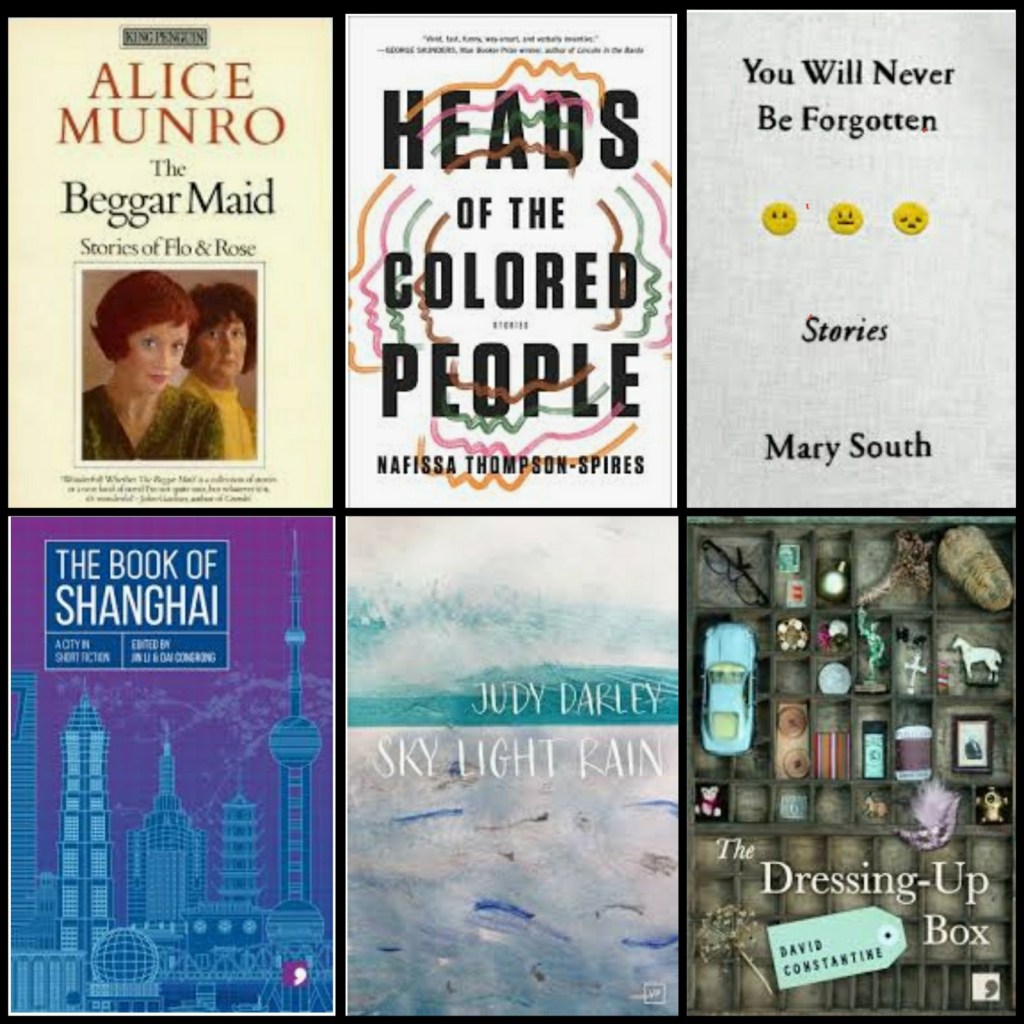
Just looking at that collage of cover collages (a meta-collage?!) makes me happy! So many beautiful books! I’d love to hear what you’ve enjoyed reading so far this year, and if you’ve read any of my list!

Short Stories: The Beggar Maid; Heads of the Colored People; You Will Never Be Forgotten; The Book Of Shanghai; Sky Light Rain; The Dressing-Up Box

I love the power of the short story form. I was quite shocked to realise I have only read six short story collections/anthologies so far this year – I am sure I read far more last year. So I thought it would be fun to do a quick summary post on the ones I have read, if only to remind myself how much I love short stories!

The Beggar Maid by Alice Munro (1972)

There’s always another Munro collection to read, and it is always a pleasure. This one, subtitled ‘Stories of Flo and Rose’, is more novel-like than previous collections I have read. Spanning nearly forty years, it explores the complex relationship between Flo and her stepdaughter Rose, though the focus is more on the latter. These linked stories are, as I have come to expect from Munro, insightful and true, and helped me to define what it is that I find so extraordinary about her work. Nothing is simple or universal in Munro’s world: every interaction is unique, a product of the whole of the characters’ histories, everything they are and that has shaped them.

I find myself wondering how on earth she writes with so much truth – is it by keeping her subject matter close to her own experience, following the infamous advice to ‘write what you know’? Whatever the secret, reading a Munro story is like reading a document of reality rather than anything that could be termed mere fiction – a very special experience indeed.

Heads of the Colored People by Nafissa Thompson-Spires (2018)

This short story collection is full of self-awareness and a cool irony, delving into the needling questions of what it means to be an upper-middle-class Black person in modern America. Set apart as much by privilege as by race, the characters in these stories find themselves the only Black students at a private school, in a yoga class, and so on. The humour here is biting – in the letters between two highly educated mothers of private school girls, Thompson-Spires flirts with total parody, and in a later story, she manages to make a story about a woman with a fetish for amputees very funny indeed. Social media references abound, with one story in particular, ‘Suicide, Watch’, exploring the Instagram lifestyle in full comi-tragic glory, posing the question of what it means to be ‘Black’ when there are so many other identities to worry about these days. The collection as a whole is strengthened by recurring characters, and I found it full of a refreshing sharpness, zesty and full of life. I hope to read more by this author.

You Will Never Be Forgotten by Mary South (2020)

This is a fantastic collection of stories, full of a Black Mirror-style slantwise examination of our possible near future. You can read my full review of You Will Never Be Forgotten here.

The Book of Shanghai edited by Dr Jin Li and Dai Congrong (2020)

Part of the Reading the City series by the always brilliant Comma Press, this anthology is the perfect introduction to Shanghai. I am a big fan of literature in translation, and always looking for more recommendations. I’ve got The Book of Cairo on my TBR, and will be adding more from the series for sure. My full review of The Book of Shanghai is here.

Sky Light Rain by Judy Darley (2019)

I was thrilled to be approached by the author to review her book of short fiction, published by Valley Press. You can read my thoughts here: this collection is a glorious mixture of nature and myth, and a testament to the boundless imaginative possibilities of the short form.

The Dressing-Up Box by David Constantine (2019)

Another gem from Comma Press, you can read my full review of this book, which has just been released in paperback, here. I am amazed that this was the first time I had come across Constantine, who is a master of the short story, and I will definitely be checking out his past collections.

Compared to the number of novels I have read this year, six short story collections/anthologies is pretty poor. I have a few more lined up; most excitingly, Anna Vaught’s Famished, which is out in September from Influx Press, and promises to be just as staggeringly brilliant as her novel, Saving Lucia, which I read earlier this year. But PLEASE hit me up with your suggestions for story collections both old and new – I need to make sure I am not neglecting this wonderful form of fiction!

Review: The Distance From Four Points by Margo Orlando Littell (2020)

Blurb

Soon after her husband’s tragic death, Robin Besher makes a startling discovery: He had recklessly blown through their entire savings on decrepit rentals in Four Points, the Appalachian town Robin grew up in. Forced to return after decades, Robin and her daughter, Haley, set out to renovate the properties as quickly as possible—before anyone exposes Robin’s secret past as a teenage prostitute. Disaster strikes when Haley befriends a troubled teen mother, hurling Robin back into a past she’d worked so hard to escape. Robin must reshape her idea of home or risk repeating her greatest mistakes. Margo Orlando Littell, author of Each Vagabond by Name, tells an enthralling and nuanced story about family, womanhood, and coming to terms with a left-behind past.

Review

One of the best things about getting involved with Book Twitter and sharing my blog with more than two people is that I have been introduced to some fantastic books that I might not otherwise have come across. I want to thank Lori @TNBBC for getting in touch with me, and for offering me a copy of The Distance From Four Points in exchange for an honest review. Do follow her on Twitter and check out the eclectic mix of books that she promotes – I have my eye on several more!

Margo Orlando Littell’s novel was a real experience for me – it was one of those books that crept up on me slowly, and revealed layers of meaning that I was not expecting when I started reading. It begins with a simple premise: Robin and her teenage daughter are forced by circumstance to move from their comfortable lives in suburbia into one of the decrepit rental properties her husband bought before his death in Robin’s home town of Four Points. At first I was slightly taken aback that the ‘secrets’ of Robin’s past were almost casually revealed in the opening chapters – we learn very early on that she had been a sex worker as a teenager – but it gradually became clearer and clearer that I had underestimated the author and the book itself. This is not a sensationalist account of the past coming back to haunt a reformed character: it is a different kind of reckoning, a lesson in acceptance and finding peace. As with the very best fiction, I learned a lot from reading this book.

As the story develops, so the language becomes more nuanced and descriptive, and from my initial impressions of this being quite a straightforward book, I moved towards being both emotionally and intellectually challenged by the characters and the themes of this novel. I have to admit, I did not warm to Robin at first: I found her behaviour quite hard to fathom, and her rejection of her former friend, Cindy, when they first meet again after twenty years or so, actually made me feel quite antagonistic towards her. However, as their relationship develops and their lives become more entangled, I found myself beginning to understand both women, in a way that reflects the depth that Littell manages to create in her characters. Robin and Cindy became real to me, and Cindy in particular provides the novel with both humour and heart, without any cloying sentimentality. Other characters, too, are much more than they first appear: the landlords, the ex-lover, the teen mum – each is three-dimensional, complex, intriguing. These are characters who are only familiar on the surface – Littell reveals their uniqueness and, I think, in doing so, questions the reader’s own assumptions alongside Robin’s.

The descriptions of the crumbling, decaying properties and the physical labour needed to repair them to even a semi-acceptable level were another highlight of the book for me, as well. I was very interested to find out that in her research, Littell unwittingly became a landlord herself (you can read about her experience here) – and her prose certainly has an authentic ring to it. The tension between the gentrification process and the landlords’ need to make a living was also something I had never considered. The author’s determination to show every side of the argument is more than just commendable – it is REAL, it reflects the messiness of life in all its complications, rejecting false dichotomies and revelling in the prismatic, multi-faceted nature of human experience.

I haven’t read many novels that have sent me on a similar trajectory of starting out complacent and then catching myself and realising I had grossly underestimated the book, and it was a really interesting experience. This book is so much more than it seems, and it surprised me at every turn. I would be very interested to read her first novel, Each Vagabond by Name, and will certainly be keeping an eye out for more works by this quietly subversive author.

The Distance From Four Points is out now, published by the University of New Orleans Press.

Review: The Dressing-Up Box by David Constantine (2019)

Blurb

Against the backdrop of war, a group of children barricade themselves in an abandoned townhouse, cherishing what’s left of their innocence with the help of a dressing-up box…

An ageing widower moves into the shed at the end of his garden to plan out his ‘endgame’ surrounded by a lifetime’s worth of hoarded curiosities…

The characters in David Constantine’s fifth collection are all in pursuit of sanctuary; the violence and mendacity of the outside world presses in from all sides – be it the ritualised brutality suffered by children at a Catholic orphanage, or the harrowing videos shared among refugees of an atrocity ‘back home’. In each case, the characters withdraw into themselves, sometimes abandoning language altogether, until something breaks and they can retreat no further.

Review

I don’t quite know how I have never managed to come across David Constantine’s work before, but, it has to be said, my failing quite pleases me, because I now have his entire ‘back catalogue’ to look forward to. I love a good short story collection, and I love being introduced to writers I haven’t read before, so I was delighted to receive an ARC of this book ahead of its paperback publication date. Many thanks to Zoe at Comma Press for my copy. The review below is my honest, unbiased opinion.

The sixteen stories in this collection are powerful, both individually and when taken as a whole. Constantine is a remarkable writer, able to blend personal, intimate moments with wider political implications, zooming in and out of the human experience in a seamless manner. There were two or three stories which didn’t grab me as strongly, but I suspect this is at least partly because Constantine’s work requires quite intense concentration; it seems to me to be the kind of book that would reward careful reading and rereading. Having said that, when I tried to pick out a couple of favourite stories, I ended up choosing half of them!

The opening story, ‘The Dressing-Up Box’, is stunning. The premise of a group of children forming their own mini society has, of course, been done before, but what struck me here was the trust placed in the children by the author – there is no Lord of the Flies anarchy here; instead, acceptance and empathy govern the children’s actions. When the newcomer, Monkey, discovers the treasure trove of dressing-up clothes beneath the floorboards, the delight and excitement is palpable. The way in which the children are able, even in these extreme circumstances, to let their imaginations run riot, and not to lose that sense of wonder, is beautifully depicted. As a first introduction to Constantine’s writing, it blew me away, and reminded me of the power of the short story form.

As I mentioned, there were several other stories that really stood out for me. ‘Siding with the Weeds,’ in which Joe visits his old friend Bert, who is now more or less living in a shed at the end of his garden, is such a subtly surprising story, full of gorgeous nuggets of prose – when Bert reveals the full version of the ‘beautiful clean thought’ he had started to write down, I honestly felt something break in my chest. Constantine’s writing contains many of these moments, heartbreaking in their truth and beauty. In ‘The Diver’, Lucy accompanies her father on one of his expeditions, and the events that unfold perfectly encapsulate those moments of near-trauma that can mark us almost as much as the real thing.

Constantine’s work is also timely. In ‘Rivers of Blood’, two elderly people reflect on their experiences of the demonstrations resulting from Powell’s infamous speech, and in ‘Seeking Refuge,’ Fahrid struggles to move on from what is happening back in the country he fled. In ‘bREcCiA’, the strange book made up of collages of images and texts, which so captivates the protagonist, seems to encompass the entire modern world in its pages, showing the true scope of Constantine’s concerns.

‘When I Was a Child’ is perhaps the most emotionally powerful piece in the collection, describing the covert horrors of life in the House of the Brothers and Sisters of Mercy, an orphanage. What happens with White Star is chilling – I shall say no more here, but Father Dominic is a dark, dark villain. Even in this bleak story, though, there is a hint of hope at the end. This is brought to the fore in the final story in the collection, ‘Ashton and Elaine,’ a deeply moving piece which brings the book in a full circle back to the optimism we can have in the goodness of children. It is a cliche to label them our hope for the future, but Lord knows in these times, our hope has to come from somewhere.

I was captivated by this collection, which takes the reader on a journey between emotion and intellect, politics and the personal, and I would recommend it to anyone who reads in order to think more deeply about ourselves as human beings. It is powerful stuff.

The Dressing-Up Box is published by Comma Press. The paperback edition is out on 25th June and is available to pre-order here.